
Summary
Despite its remarkable advances in other areas, including image creation, generative AI has so far been useless for technical drawing. As recently as the spring of 2026, the strongest AI models could produce only crude and cartoonish technical drawings. But the frontier models released in the summer and fall of 2026 have improved dramatically.
Drawing upon my background as an architect, I tested 13 older and newly released AI models to measure their technical drawing abilities. I found that the strongest drafting model at the time of writing is Anthropic’s Claude Opus 5.5, released in September of 2026. With some skilled guidance, Opus 5.5 is capable of producing sophisticated drafting and permit-quality architectural drawing sets for simple buildings.
Because of the suddenness of the change and because extracting the best results from the models requires careful prompting, the architectural profession seems mostly unaware of these developments. But AI’s technical drawing capabilities are likely to keep improving rapidly. Architects and related professionals are poised to experience the shift that software engineers experienced during the past year, in which direct, manual production of technical drawings is replaced by supervision of AI models that grow increasingly capable of complex technical drawing tasks.
Introduction
Technical drawing, or drafting, is the production of scaled drawings that describe how buildings, machines, and other objects are assembled. Before the computer era, drafters drew technical drawings by hand with straightedges and other drafting tools. When computer-aided design (CAD) software began to take over in the second half of the twentieth century, it first consisted largely of programs like AutoCAD that focused on two-dimensional drawing. Later programs, like SolidWorks and Revit, incorporated three-dimensional drawing and parametric modeling, allowing complex assemblies to adjust automatically and deterministically when a drafter changes a single variable. CAD has changed the drafting process, but humans have remained fully in control.
I’m an architect and have worked in the building industry since the 2000s. I’ve followed the development of generative AI closely for years, but its earlier progress, though impressive, was irrelevant to my core technical drawing competency. I tried the new models as they were released but found that they had no real abilities in this area. Even their image generation capabilities were relevant only to artistic rendering work, a relatively small, specialized area within architecture and related professions.
But the situation has changed dramatically in 2026, especially in the past several months. Experimenting with the latest models, first casually and then more systematically, gave me a growing sense that architects are in the position of Wile E. Coyote in the old cartoons, hanging for a moment in the air over a canyon.
First Test: Construction Set
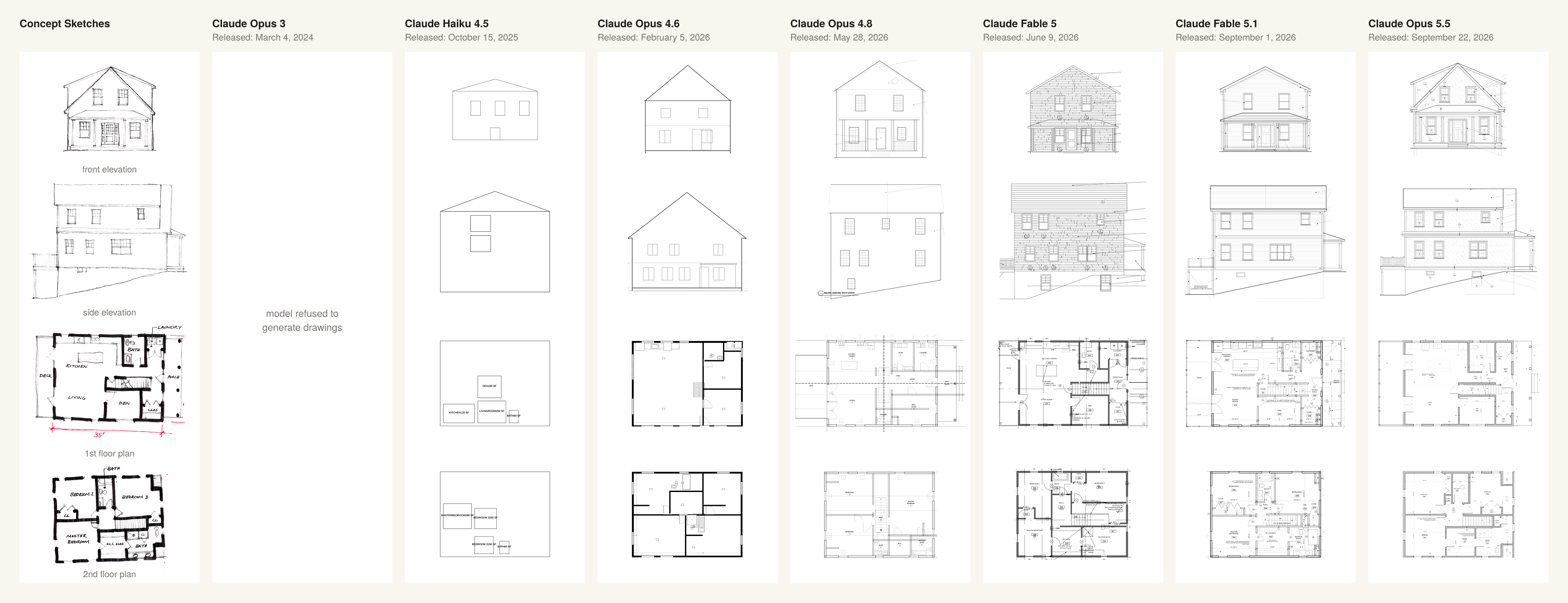
My first test measured AI’s ability to generate an entire construction document set, or “blueprint” set, for a new house from scratch. I ran the test on 13 separate models, giving each the same initial prompt and context. The files in the starting context folder consisted of 1) rough concept sketches that I drew for a simple house, and 2) a reference construction document set for a different house that I drafted several years ago with AutoCAD. The concept sketches are simple, but they contain enough information that an experienced drafter could use them to produce a complete drawing set for the house’s permitting and construction.
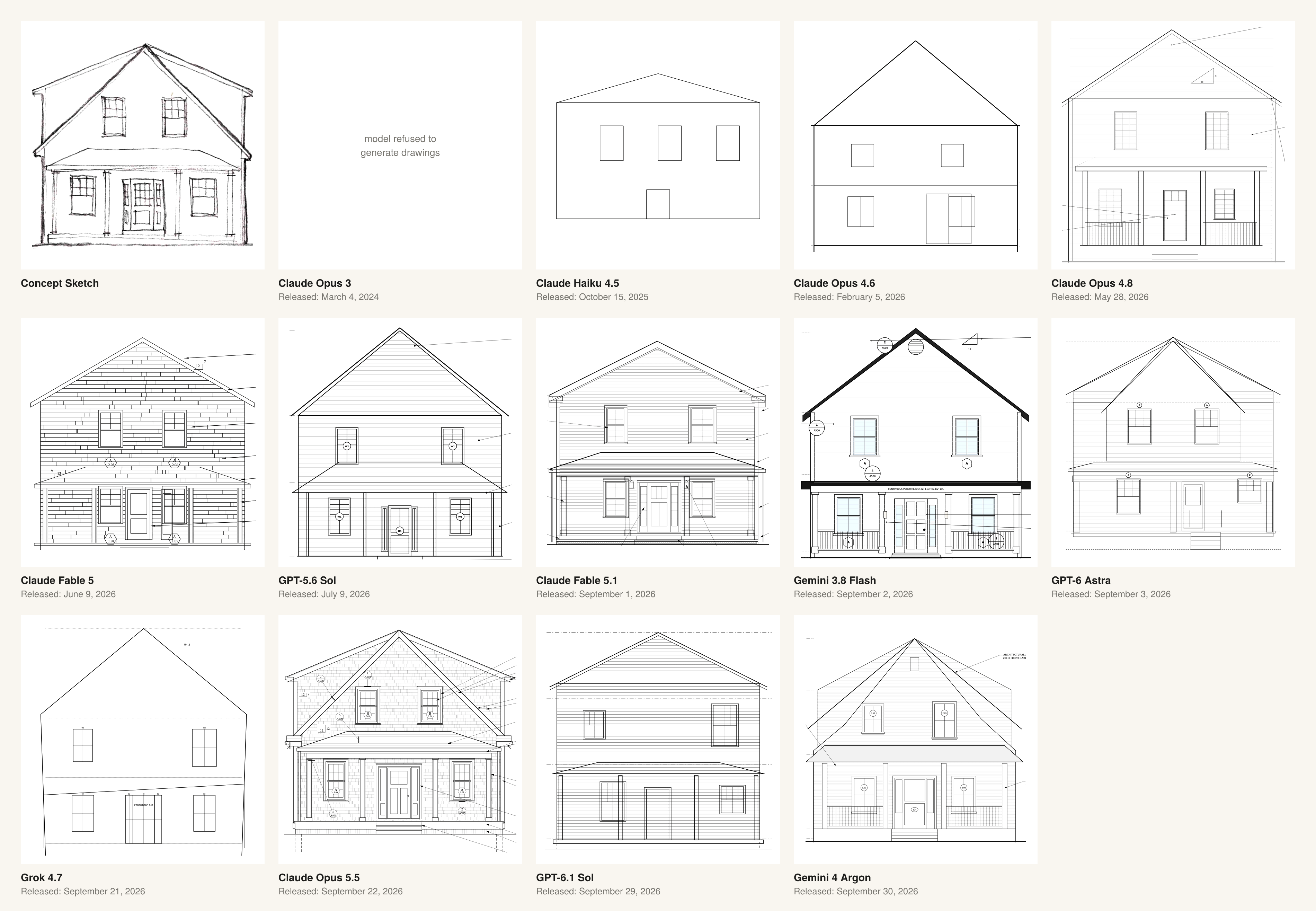
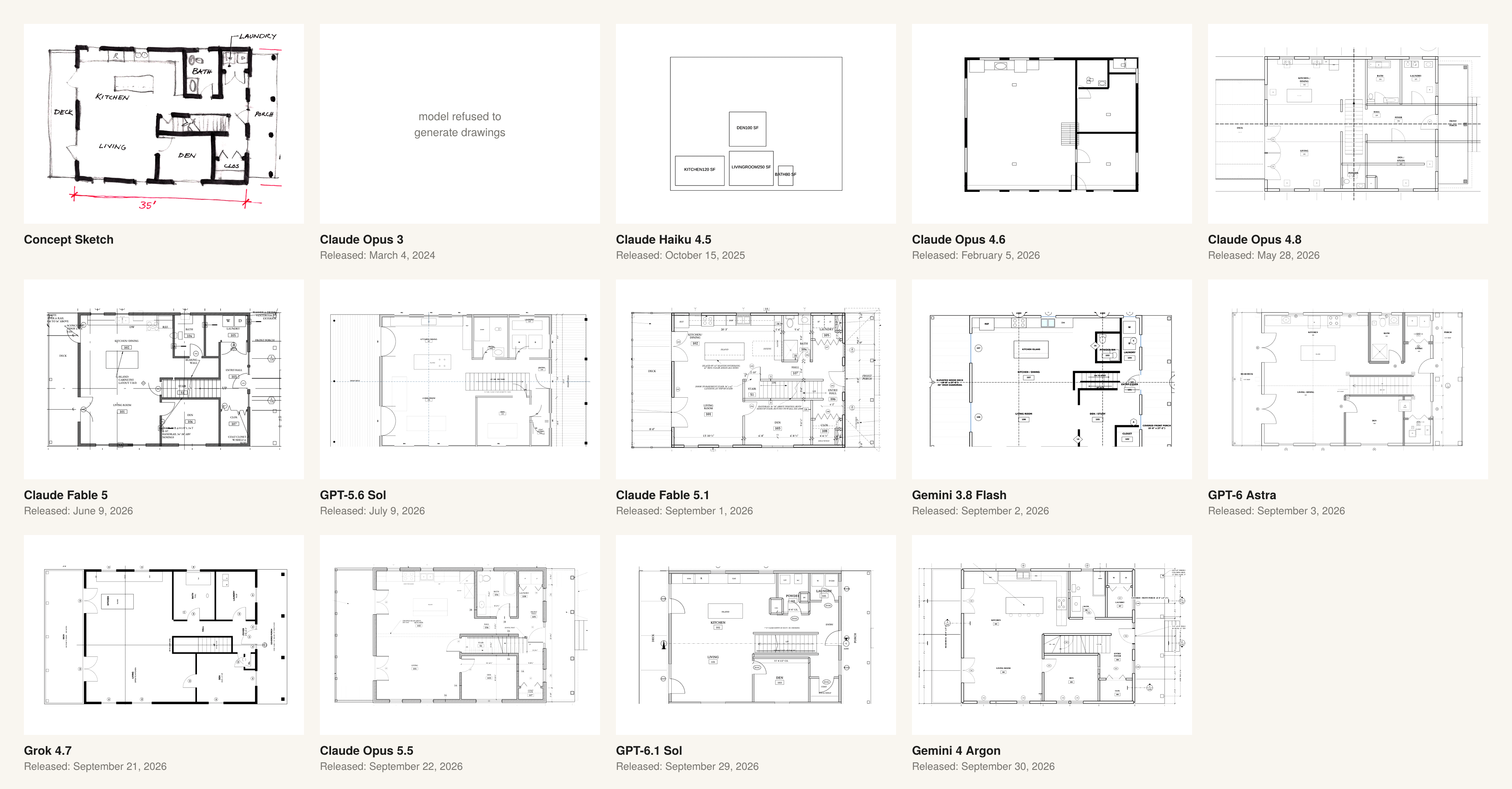
The results ranged from a refusal to produce drawings (Anthropic’s Claude Opus 3, released in 2024), to simple, cartoonish drawings (mainly from the 2025 and early 2026 models), to a set that is, in my judgment, good enough to obtain a building permit (Anthropic’s Claude Opus 5.5, released in late September of 2026).
The drawing sets were generated by the AI models directly, without any use of existing CAD software.
An important caveat is that these results reflect varying amounts of my “human-in-the-loop” feedback during the models’ work on the task. It would be hard to provide exactly the same amount of correction to each model, given the wildly varying quality of their initial work, so the best way to make things absolutely even would be to provide no feedback at all, making the models generate the set without any human involvement. But that approach, though it would be a more rigorous test in some sense, wouldn’t provide a realistic view of the models’ usefulness in architectural practice, where it’s normal for senior architects to “redline” the draft sets produced by junior employees.
I provided no feedback to the worst models, since they weren’t up to the task, and limited feedback to some of the others. Opus 5.5’s initial draft was the best, so I gave it the most feedback, consisting of a number of written comments and two rounds of redlined sets. Redlining Opus 5.5’s drawings felt surprisingly routine. Many of the flaws in its drafts were similar to those you might find in the drawings of a talented but inexperienced person, and it made revisions in response to my redlines just as a human would.
It’s worth emphasizing how recent much of the models’ improvement has been. None of the models released prior to September was able to draw the floor plans without significant errors in the basic layout. Only Opus 5.5, released on September 22, had both the spatial understanding and drafting ability to draw the dual-pitch roof design correctly. The outlier among the September models was Grok 4.7, whose output was generally weak and whose elevations in particular are amusingly bad.
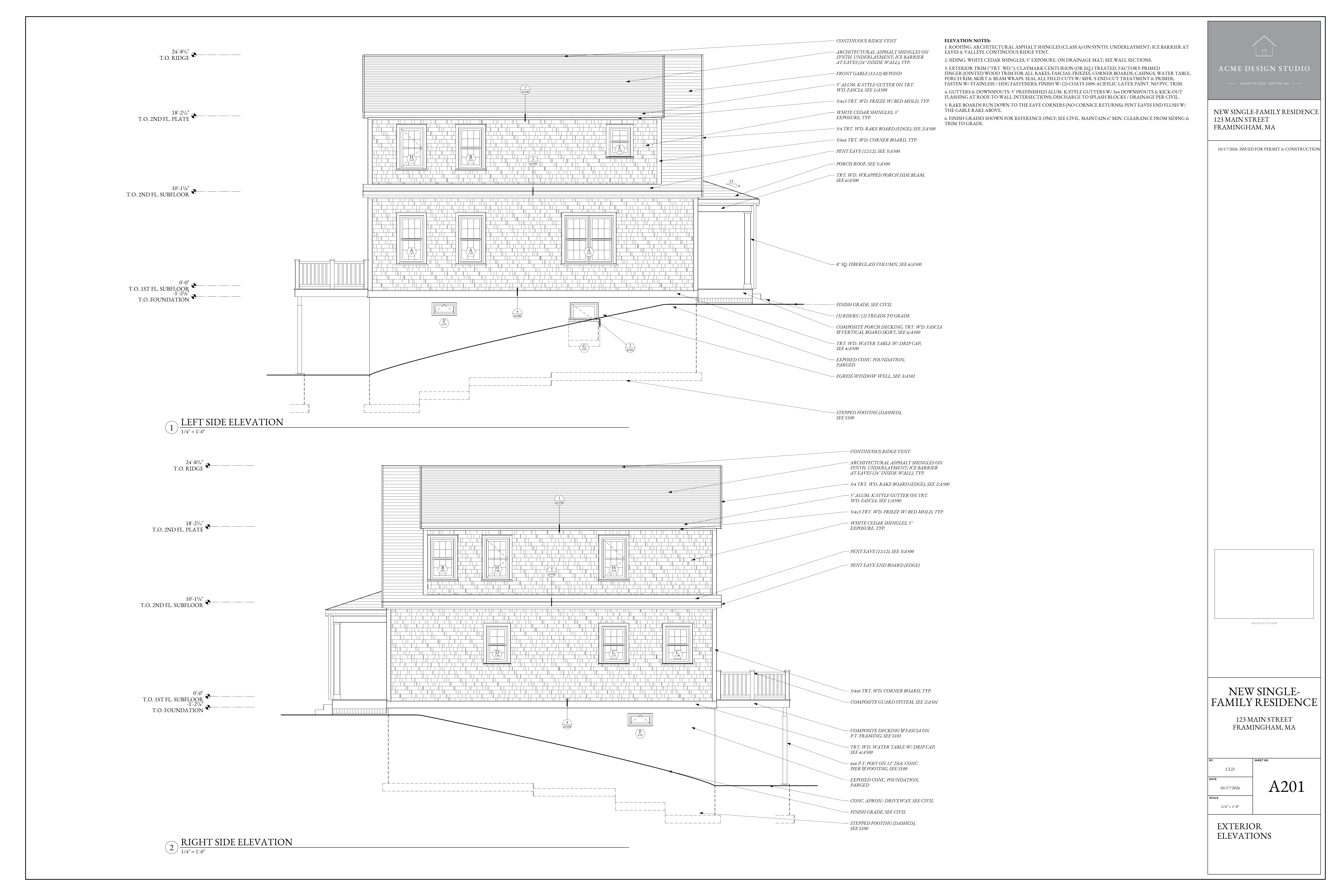
The house in this test is a fairly simple building, and even Opus 5.5’s set is far from perfect.1 But the quality of the drawing sets done for single-family homes varies quite a bit, and the cheap end of the market includes a lot of mediocre work. With the right guidance, Opus 5.5 is arguably better than the low end of the human market right now.
Second Test: Measured Drawing Skill
The construction document test is a test of drafting ability but also of other things, like knowledge of building codes and written specifications. But what about a test of the craft of architectural drafting, of the models’ ability to draw complex and beautiful architectural working drawings?
Some of the best examples of this kind of drafting can be found in the book Building Details, a compilation of the hand-drafted architectural detail sheets of the early-twentieth-century architect Frank Snyder. Snyder was a drafting virtuoso, and his drawings are extremely impressive, rising to the level of artwork.
I gave Anthropic’s Claude Opus 5.5 a folder that contained a number of Snyder’s drawing plates. I also gave it photographs and a disorganized stack of rough field sketches of a historic building that I measured a few years ago, and told it to detail the building, following Snyder’s style of drafting and sheet composition. In a way, Opus 5.5’s task was harder than Snyder’s, since Snyder had access to the working drawings for the buildings whose details he drew. Opus 5.5, by contrast, had to draft the building’s plans, elevations, and details from my photos and rough, disorganized sketches (a complicated and tedious job for a human drafter) and had to infer the construction of concealed assemblies from their exposed surfaces.
I told Opus 5.5 to give me several progress deliverables, gave it some written comments and redlines when I received them, and then had it finish the drawings. Its final output consists of two sheets in Snyder’s standard format, one depicting the building’s overall layout and elevations and the other a compilation of details.
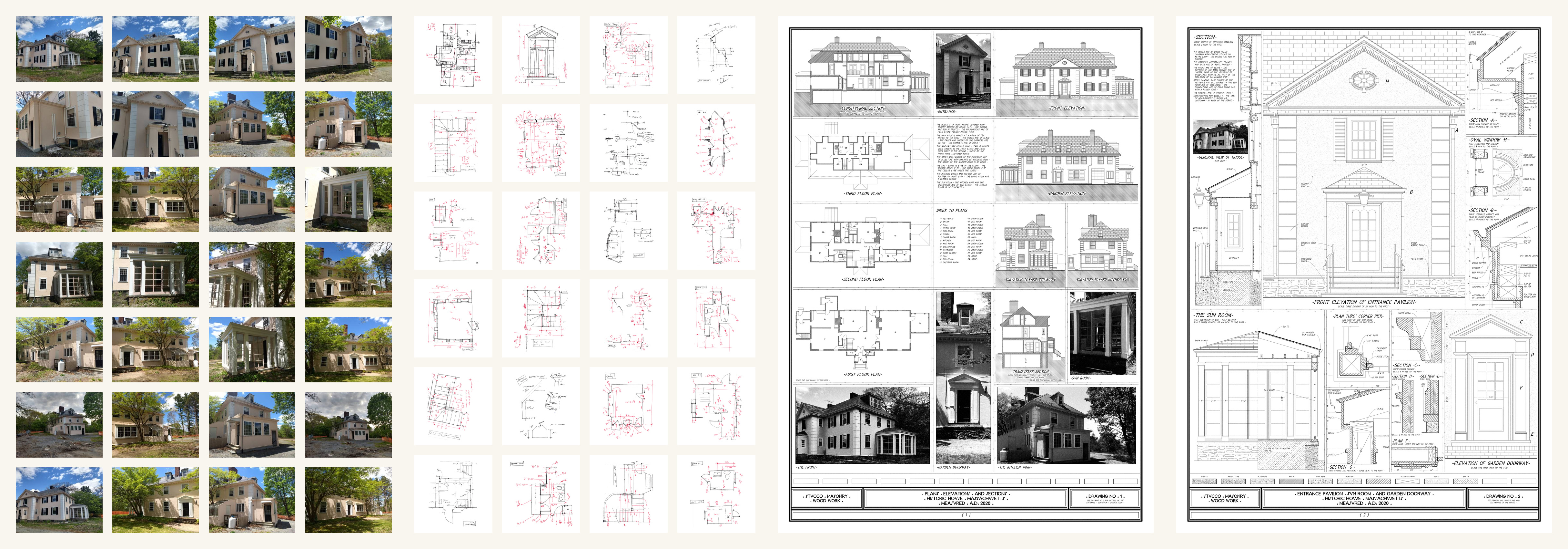
Do these Opus 5.5 drawings clear Snyder’s high bar? No: the drafting isn’t nearly as polished as Snyder’s, although it’s better than the work produced by plenty of architecture firms. And, even after my redlines, the details contain some subtle errors that wouldn’t be made by a skilled architect with experience in this type of construction. But they are pretty impressive. And the model completed them in a small fraction of the time and cost of a skilled human.
Method
Despite any superficial similarities, the drawings produced in these tests are not the kind of AI-generated images that have been around for a few years. These drawings consist of vector linework, easily scaled and editable in CAD software.2 However, the AI models did not use any existing CAD software to make them. They wrote code in Python to describe the linework and printed the sets directly from the code.3
The older models generated their low-quality results fairly quickly, but it took Opus 5.5 twelve hours to draft the house set, and the compute cost a few hundred dollars.
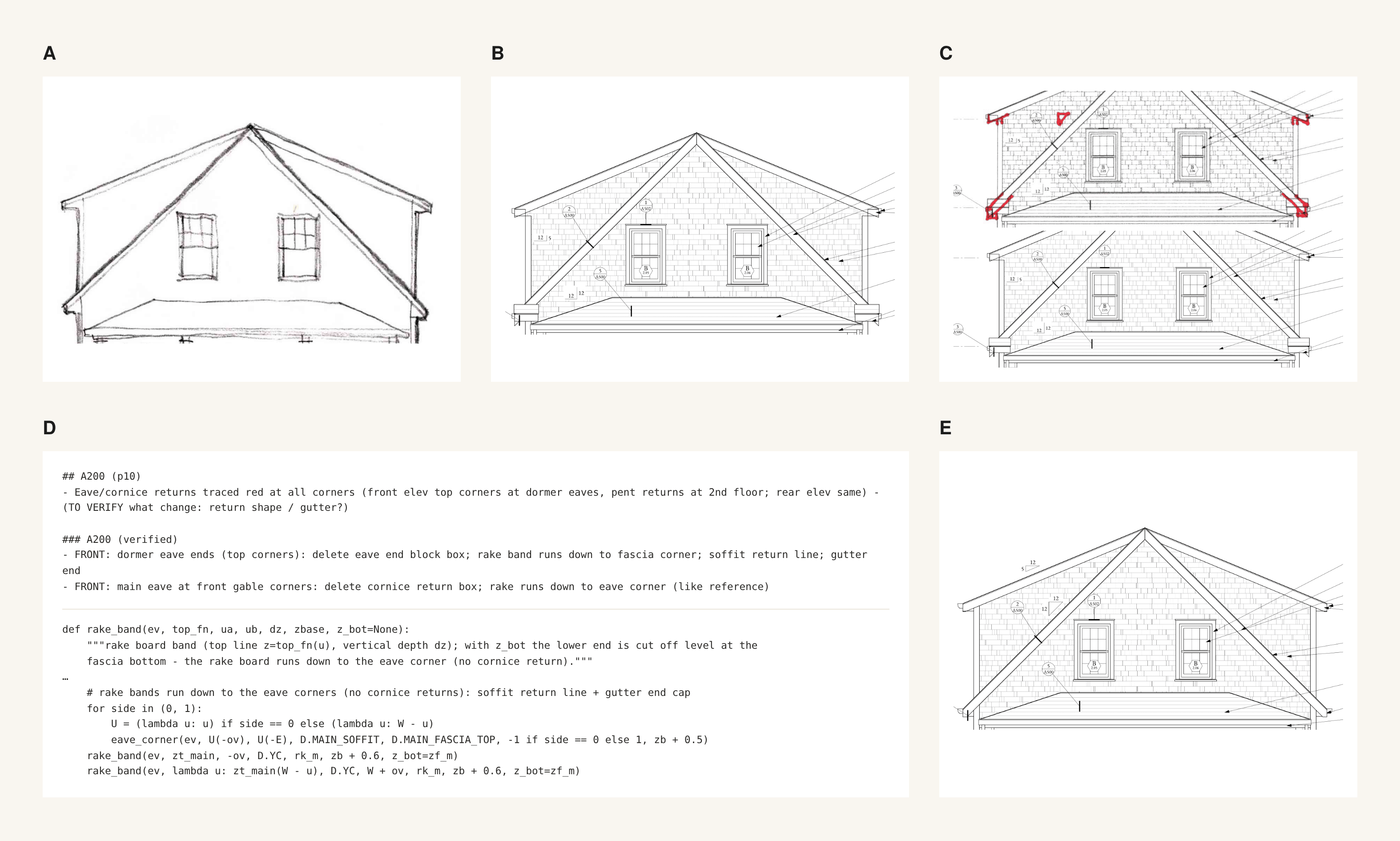
The stronger models approached the drafting task in about the same way. They viewed and interpreted the input sketches, wrote code to generate linework, generated test prints from the code in order to visually inspect them for correctness, and then revised the code until they decided that the set was ready to print. The stronger models incorporated additional quality checks; for example, Opus 5.5’s final code included a module that checked to see whether notes and tags obscured the underlying linework, and shifted their locations when they did.
One difference between the weaker and stronger models seems to be scale, across a number of variables. The stronger models worked for much longer, generated much more code (in the case of Opus 5.5, more than 15,000 lines of Python code), generated many more images of their draft outputs, and then adjusted their code, based on those drafts, in more iterative loops.
An interesting question is why the models were so incapable of doing technical drawing until recently, and why the recent models have improved so rapidly. I can only speculate, but it seems plausible that the models’ technical drawing skill is a composite that involves a number of component skills, such as vision, spatial reasoning, and coding, and that the composite skill can’t emerge until each of the component skills is reliably present at a sufficient level. So, the technical drawing ability was absent while the component skills were improving gradually but still under the minimum required thresholds, and it appeared relatively quickly once they passed those thresholds.
Improvements
The models will get a lot better at drafting than they are now. A number of levers are waiting to be pulled, any of which will improve drafting output and the combination of which will improve it more. For example:
1. Tooling. A substantial portion of the time that Opus 5.5 spent on the house project was allocated to extracting drafting standards from my reference set and writing a sophisticated but convoluted CAD drafting program.4 There is no reason that either of these tasks needs to be completed for every drafting task. The code for each could be optimized and then pre-loaded at the start of new drafting tasks, allowing end users to improve both the speed and the quality of the model’s outputs without any involvement from the AI labs.
2. Pre-training. As better base models are trained and released, their higher general competence will produce better results on technical drawing tasks, even if those tasks are not direct targets of the AI labs’ training efforts.
3. Post-training on related skills. As the AI labs continue to devote post-training effort to improving specific skills, like coding, that the models rely upon for technical drawing, the models will get better at technical drawing even if the post-training is not directly focused on it.
4. Post-training on technical drawing. The AI labs will make technical drawing a direct target of post-training, producing narrower but substantial improvement in this area.
In short, there’s good reason to believe that there is still a lot of low-hanging fruit, and that the models will be a lot better at technical drawing when it is picked.
Training New Architects
Architecture schools now have the same problem that faces other academic disciplines. It has become possible for students to quickly “vibe draft” design projects that would have taken them weeks or even months in the past. This won’t help them learn architecture any more than a term paper churned out by ChatGPT helps them learn literature. I assume that many architecture programs will embrace this use of AI. Perhaps others will go in the opposite direction, making their students do old-fashioned hand drafting, the architectural equivalent of handwritten blue-book exams.5
After they graduate, it’s not clear how early-career architectural staff will be able to effectively supervise an AI model’s production of technical drawings if they haven’t done much drafting themselves. I can redline Opus 5.5’s drafts competently because I have years of experience doing that kind of drawing work.
Architecture firms could take on junior employees who they know will not be productive for some time, but firms that incur that extra cost will be at a competitive disadvantage against other firms that don’t. Needless to say, this problem is not limited to the architectural profession.
Architectural Business Models
A large fraction of architectural firms’ billings is for technical drawing production. AI will almost certainly make technical drawing cheaper to produce, and competition between firms will put downward pressure on fees unless the quantity of technical drawing increases in response to the price change.
Will the quantity of drawing increase? Arguably, not much. In economic terms, construction document sets are not “final goods” sold directly to end users but “intermediate inputs” used for the development of the physical buildings they depict, and the cost of the construction set is a small fraction of the total development cost of a building. Most of a building’s development cost goes to the construction itself, which is heavily influenced by unrelated factors like commodity prices. So, even a dramatic decline in the cost of construction documents would have little effect on the total development cost of new buildings, and therefore would not spur much of an increase in the number of new building projects and associated drawing sets.
There are some reasons why the above argument might be wrong. For one thing, full construction sets provide the best basis for accurate construction pricing. Typically, construction pricing happens iteratively as the design proceeds, starting with preliminary pricing that is based on early schematic drawings and contains a significant margin of error. Then, scope adjustments and updated drawings are done in response to the preliminary pricing, and so on until pricing is finalized on the basis of a complete set. Although the initial pricing would be more accurate if the initial drawings were more detailed, it doesn’t make sense to pay the architect a large fee to develop a full set for a scope that might change. If, however, the price of construction documents dropped substantially, it could become rational to do a complete drawing set for every design iteration, making initial pricing more accurate and the subsequent scope adjustment process more efficient. This could make the demand for construction document production somewhat more elastic.
Another possibility is that clients and governments will adjust to the new situation by demanding more documentation. Property owners will request elaborate construction sets for smaller projects that now get by with limited documentation, and more expansive documentation for projects that already require plans and specs. And regulators will lock in these changes by getting used to the added documentation and making it mandatory.
Conclusion
The drafting abilities of the current models remain limited, but the main takeaway from this exercise should be their trajectory of improvement, not the situation at this exact moment. Given their rate of improvement and given what we know about how they work, we should assume that they will get much better at drafting in the relatively near future, with profound implications for architecture and related professions. I can’t say that I’m cheering for the change; it’s sobering to see skills that I developed through years of effort be made less valuable by new technology. But, like it or not, that is where we’re heading.
Appendix
Full construction sets in order of model release date:

For example, the Opus 5.5 design lacks a second means of egress, which is a state code violation and would probably be flagged by a building inspector. The text of the base International Residential Code in use in Massachusetts allows dwelling units to have only a single means of egress, but a Massachusetts state amendment increases the minimum to two. This error is partly my fault, because I didn’t include the second egress path in the concept sketch, but it’s an easy thing to fix, and something that should have been caught. The two September OpenAI models did catch my mistake and addressed it by adding stairs off the rear deck. This kind of error could be made less likely with better tooling in the form of a standalone building code check module.
Among other options, the kind of Python code written by the AI models to solve these drafting tasks can directly print PDF drawing sets or generate DXF files that can be opened in, edited in, and printed from programs like AutoCAD.
Code that generates linework has been around for as long as CAD software has been around. Autodesk released AutoLISP, which is capable of generating any arbitrary linework from code, in the 1980s. But it would be hugely inefficient for humans to create linework for complex one-off geometries by writing code rather than by simply using the CAD software’s graphical interface, so AutoLISP and other languages have generally been used to automate the drafting of specific repetitive elements, not to create entire complex drawings from scratch. Frontier AI models, however, can generate high-quality code so quickly that this approach is actually feasible for them.
When I looked at the code that Opus 5.5 wrote to create the house set, I found that it went beyond hardcoding the locations of objects in a Cartesian coordinate system and went part of the way towards creating a parametric model. But only part of the way, because the coordinates of many objects were still hardcoded. When I tried manually editing the Python file that controlled the building’s length, I found that the elevations did actually stretch when I increased the length, but that many of the plans did not, even though the dimensions tied to the plans did stretch. So, although the codebase was sophisticated and solved the specific requirement effectively, it was clunky and filled with problems that appeared when the requirement changed. This code could be improved so that it could be used for other building layouts without being substantially rewritten each time.
Counterintuitively, the ability of computers to do technical drawing could strengthen the case for human hand drafting. CAD and BIM software began as technical drawing tools, but they made major inroads into the earliest design stages, where their rigidity makes them somewhat worse fits. The professional rationale is that the computer software is going to be used for construction documents anyway, so project workflows are more efficient if the construction document process can pick up where early design left off, rather than starting from scratch after the early drawings are done by hand. But the introduction of AI technical drawing could change existing workflows in a way that removes the inefficiency associated with hand-drawn early design.
Thanks that was insightful. I agree about schooling but I want to add that arch. schools will need to stop teaching the tools but more the skill at a fundamental level. They will have the time now and actually spend quality time on the art of architecture and not be hemmed in by the limitations of an incumbent tool (Rhino, Revit, etc.) at 2am before a studio presentation lol.
So they might in fact aggressively go back to a more "hands on" approach with teaching architecture (model building, life drawing, hand drawing etc.) as the curriculum doesn't need to worry about the digital tool so much anymore..
I did an exchange at Mario Botta's school in Switzerland and we would just build hundreds of wood / cardboard / styrene models all day, every day.
The point is, I think more of this hands on education is coming and has to come if architects intend to understand design at all in an age of AI abundance.
Could be a Renaissance!
The architecture profession has always struggled with a paradox. Their best work—the design thinking, the programming, ideation and concept work—is frequently given away for free through a design competition, or at cost if there is a stipend offered. The higher-value work is paid the least and the production work, which is more of a commoditized process, is where the fees are made. With AI ultimately being able to do the production work faster and cheaper, architects are in a bind. They need to be paid more for their high-value front-end work.
As with all technology, expectations will rise to meet the technology. We will eventually see a world where once a concept is approved, the completed production drawings will be expected in days or weeks, not months and at a significantly lower price.
On the positive side, this might be bringing back the original notion of the architect as builder, with integration of design drawings, fabrication/shop drawings, and construction. Price guarantees will be able to be achieved early in the development process and therefore financing of projects realized sooner and project timelines shortened (the front end takes so long!)